
Why You Need a Canada Study Visa Consultant in 2026
Yes — this page is for Indian students applying for a Canada study permit, and it explains exactly how the right consultant raises your approval odds in a tougher 2026 system. If you want a quick read on where you stand, book a free eligibility assessment before you read further — it takes minutes and shapes everything else.
Canada is still one of the most rewarding study destinations for Indian students, but the application has changed more in the last two years than in the previous decade. The Provincial Attestation Letter, the national study-permit cap, tighter financial scrutiny in the regular stream and program-eligibility rules for post-graduation work have turned a once-forgiving process into one where small mistakes cause refusals. A consultant's job in 2026 is no longer 'form filling' — it is risk reduction.
Here is the insight that reframes everything: most refusals today happen not because students are ineligible, but because the application fails to answer the officer's underlying concerns about study rationale, financial capacity and temporary-resident intent. The IRCC officer is assessing study-plan credibility, source-of-funds verification and whether you are a genuine student — and a file that does not speak to those concerns directly is the file that gets refused. Our entire process is built around answering them before they are ever raised.
What a Canada Study Visa Consultant Actually Does
A genuine study visa consultant assesses your eligibility honestly, aligns your course and country with your background, builds an SOP around the genuine-student expectation, reviews how your funds are sourced and seasoned, audits the full application before submission, scores refusal risk, and — if a refusal has already happened — reads the reasons and rebuilds the file. It is advisory and evidentiary work, not data entry.
For the deeper financial and document detail behind this, see the financial requirements and proof of funds section further down this page, and our complete Canada study permit guide.
Canada Study Visa Approval Challenges in 2026
Approval Trends & Increasing Scrutiny
Approvals for Indian applicants fell sharply year-on-year as the cap tightened and officers scrutinised funds and study plans more closely. Verify the exact figure against current IRCC data, but the direction is clear: the bar is higher, and an under-prepared file is far likelier to be refused than it was under the old system.
Why Strong Applicants Still Get Refused
Strong academics do not guarantee approval. We regularly see high-scoring applicants refused for a generic SOP, recently-deposited funds with no documented source, an unexplained study gap, or a course that does not logically follow their background. The profile was strong; the application was not.
Common Misconceptions
- 'A high IELTS score means easy approval.' It helps eligibility, not the genuine-student assessment.
- 'More money in the bank is always better.' Source and seasoning matter more than a large last-minute balance.
- 'Any consultant can file the form.' Filing is easy; building an approvable, refusal-resistant file is not.
How a Consultant Helps After the 2024–2026 Reforms
What Changed: SDS Discontinuation, PAL, the Study-Permit Cap
The Student Direct Stream (SDS) was discontinued in late 2024, so all applicants now use the regular stream, where financial evidence is examined far more closely than the old GIC-plus-tuition shortcut. Most applicants also need a Provincial Attestation Letter (PAL), and a national cap limits how many study permits are issued — making application quality decisive.
Why DIY Applications Now Carry Higher Refusal Risk
Under SDS, a selffiled application could succeed on a simple checklist. In the regular stream, the same file is now read for fund source, study-plan logic and home-country ties. The cost of a DIY refusal is not just the fee — a refusal makes the next application harder and must be disclosed honestly.
How a Consultant Improves Your Chances of Approval
We do not promise approvals — no honest consultant can, because IRCC makes the decision. What we change is everything within your control: a course–country fit that makes sense, an SOP that satisfies the genuine-student test, fund documentation that withstands scrutiny, and an application audited line by line before it is ever submitted.
Consultant vs DIY Application: A Comparison
When You May Not Need a Consultant
Honesty matters more than a sale. If you are a well-funded master's or PhD applicant heading to a public DLI, with clearly documented funds and a course that obviously follows your background, you may be able to file confidently on your own — and we will tell you so during the free assessment. We would rather give you that answer than oversell a service you do not need.
How We Assess Your Canada Study Visa Eligibility
Before we recommend any pathway, we run a structured assessment. The goal is simple: tell you honestly whether a study permit is realistic now, what needs strengthening first, and where the refusal risks sit. Nothing is submitted until the file is genuinely ready.
Academic Profile Evaluation
We map your academic history — marks, backlogs, the level and field of prior study — against the Canadian programs that would logically follow. A mismatch here is one of the most common silent causes of refusal, so we catch it at the start.
Gap-Year Evaluation
Study or employment gaps are not automatically a problem; unexplained gaps are. We document what you did during any gap with evidence, so the file pre-empts the officer's question instead of inviting it.
Course Relevance Assessment
We check that your chosen program is a credible next step from your background and supports your stated goals. This feeds directly into both the SOP and — later — your post-graduation work options.
Financial Profile Assessment
We review whether your funds meet the current requirement and, just as importantly, whether their source and history can be documented. The review covers your six-month bank history, any sponsor's income tax returns, agricultural or business income where relevant, education-loan sanction terms, and existing liabilities — a simple debt-to-income view of whether the funding story holds together. A balance that looks sufficient but appears suddenly, or sits behind heavy undisclosed borrowing, is a refusal risk we flag early.
English Language Evaluation
We confirm your IELTS/PTE position against program and stream requirements, and where a retake would materially help, we say so. Students still preparing can strengthen scores through our IELTS & PTE coaching.
Refusal-Risk Assessment
Finally we score the file across the factors officers weigh — funds, ties, study-plan logic, document consistency — and give you a clear, honest picture of risk before a rupee is spent on submission.
The BrainEdge Refusal-Risk Framework
We organise that scoring around five risk categories, so nothing is assessed on instinct. It is a structured way to show you exactly where a file is strong and where it needs work before submission:
- Academic risk — does the program follow logically from your background?
- Financial risk — are funds sufficient, well-sourced and seasoned?
- SOP risk — does the study plan satisfy the genuine-student expectation?
- Course-selection risk — is the program PGWP-relevant and a credible step?
- Documentation risk — is the file internally consistent across every document?
This framework is genuine internal methodology, not a marketing badge — publish it as the way we assess files, and do NOT attach fabricated numeric 'scores' or success percentages to it. Its SEO value is that it demonstrates real expertise and organises high-intent information clearly, not that a 'proprietary score' is itself a ranking signal.
Canada Study Permit Eligibility for Indian Students (2026)
Eligibility in 2026 rests on a few non-negotiables. Meeting them is the floor, not a guarantee — but missing any one of them is an automatic problem. Always verify the live figures and rules against IRCC at the time you apply, as they have changed more than once.
Core Eligibility Criteria
DLI Letter of Acceptance
You must have an acceptance letter from a government-approved Designated Learning Institution.
Provincial Attestation Letter (PAL)
Required for most applicants unless exempt (e.g., some Master's/PhD at public DLIs).
Proof of Sufficient Funds
Evidence of sufficient, well-sourced funds for tuition and living costs.
Genuine-Student Intent
Intent must be evidenced through your SOP and strong ties to your home country.
Designated Learning Institution (DLI) Requirement
You can only study on a permit at a government-approved DLI. The institution's status also affects later benefits, so the choice is strategic, not just academic.
College vs University & Public vs Private DLI
Public universities and colleges generally offer the cleanest path on both attestation and post-graduation work eligibility. Some private institutions carry restrictions that affect work rights after graduation — we check this before you commit.
Provincial Attestation Letter (PAL): Who Needs It, Who Is Exempt
Most study-permit applicants now need a PAL from the province where they will study, issued within provincial allocation limits. It must be in place before IRCC will finalise many applications.
Master's and PhD Exemptions at Public DLIs
Certain applicants — commonly master's and PhD students at public DLIs — are often exempt from the PAL requirement. Exemptions change, so confirm yours against current IRCC guidance; our standalone Canada PAL guide.
The 2026 Study-Permit Cap Explained
Canada caps the number of study permits processed each year and distributes the allocation across provinces through provincial quotas, which is part of why PALs exist. Some categories — commonly master's and PhD applicants at public DLIs — sit outside parts of the cap, which can affect both PAL need and intake planning. The practical effect for you is that application quality and timing matter more than ever — a weak or late file competes for a limited number of approvals.
Common Eligibility Myths
Three assumptions cause more refused applications than almost anything else. Each one is false:
- A high IELTS score guarantees approval. It supports eligibility, not the genuine-student assessment.
- An admission offer guarantees a permit. Admission and the study permit are separate decisions made by different bodies.
- A PAL guarantees approval. A PAL lets your application proceed within a provincial quota — IRCC still assesses it in full.
How BrainEdge Improves Your Approval Chances
Approval is never guaranteed — IRCC decides. What we control is the quality and coherence of the file. Our work concentrates on the factors that most often separate an approval from a refusal.
Profile Evaluation
We start from your real profile, not a template, and build the application around your genuine strengths while addressing weaknesses head-on rather than hoping an officer overlooks them.
Course–Country Alignment
Your program should be the logical next step from your background and a sensible investment given your goals. Where a course choice undermines that logic, we flag it before it becomes a refusal reason.
Statement of Purpose (SOP) Strategy: The Genuine Student Framework
A 2026 SOP has to satisfy the IRCC genuine-student assessment. We build every SOP around three connected arguments — study-plan coherence, not generic motivation — so the file reads as a credible, individual decision rather than a template.
Academic Progression Logic
Why this specific Canadian program logically follows your Indian academic and employment history — a clear, evidenced step forward, not a sideways jump.
Demonstrating Ties to India
Concrete evidence that you would return if permanent residence does not materialise — family assets, local industry prospects, role-specific opportunities at home.
Economic Viability of the Study Plan
Why investing in tuition plus the required funds is a rational decision relative to the outcomes the program realistically opens up.
Cross-reference, do not repeat: the genuine-student logic also appears in Eligibility (where we score it) and in Refusals (where we show it failing). Each angle is distinct; link rather than duplicate. A dedicated SOP blog guide carries the framework in depth and links back here with an exact-match anchor.
Financial Documentation Review
We review not just whether your funds meet the requirement but whether their origin and history can be evidenced — the single biggest change since SDS ended. The detail is in the financial-requirements section below.
Visa Application Audit
Before submission, we audit the complete application for internal consistency — dates, names, figures and claims that must agree across every document, because contradictions read as misrepresentation risk.
Mock Interview Preparation
Where an interaction or interview is likely, we prepare you to answer clearly and consistently with your documented file, so nothing said undermines what was submitted.
How We Evaluate Course Selection Risk
Course choice is one of the most underestimated refusal triggers. We assess each shortlisted program for four things: whether it represents genuine academic or career progression from your background, whether it is PGWP-relevant, its employability signal, and the visa risk it carries. Where a first-choice program creates a progression concern, we evaluate stronger alternatives before submission rather than defending a weak choice — something most agents never raise.
As a rule of thumb, the program should read as a clear forward step:
- B.Com → MBA / Master's in Finance or Accounting
- B.Tech → Master's in Engineering / Project Management
- Diploma → Advanced Diploma / Bachelor's top-up in the same field
- Healthcare background → Healthcare-aligned PG Diploma in an in-demand field
Illustrative examples, not guarantees — every file is assessed on its own facts. A sideways or unexplained jump (for example, an unrelated short program after a strong technical degree) is exactly the pattern that prompts officer questions.
Refusal Case Handling
If you have already been refused, we treat it as a diagnosis problem, not a re-submission. Our full approach is in the refusal recovery section below.
The Canada Study Visa Process, Step by Step
The study-permit journey runs in a clear sequence. Knowing the order helps you plan intake timing and avoid the bottlenecks — admission, PAL and GIC — that most often delay applicants.
Pre-Application Risk Audit
Before anything is filed, we run your file through the five refusal-risk categories — academic, financial, SOP, course-selection and documentation — and fix the weaknesses while they are still cheap to fix. This is the step most agents skip and the one that most often separates an approval from a refusal: problems are caught here, not discovered in a refusal letter. Typical duration: a few days to a week.
Profile Assessment & Course/University Shortlisting
We assess eligibility and shortlist DLIs and programs that fit your background, budget and goals — confirming PGWP-relevance before you apply, not after. Typical duration: about 1–2 weeks, depending on how quickly documents are ready.
Admission & Letter of Acceptance from a DLI
You apply to shortlisted DLIs and secure a letter of acceptance, which anchors the rest of the application and the PAL request. Typical duration: a few weeks to a couple of months, depending on the institution and intake — the most variable stage, so start early.
PAL, GIC & Proof of Funds
With admission in hand, we arrange the Provincial Attestation Letter, the GIC, and the wider proof-of-funds package — documenting source and seasoning, not just balance. Typical duration: GIC in days to two weeks; PAL varies with provincial allocation and can be a seasonal bottleneck.
Statement of Purpose Preparation
We build the SOP around the genuine-student framework, aligned to your admission and financial evidence so the whole file tells one consistent story. Typical duration: about 1–2 weeks, run in parallel with funds.
IRCC Online Application & Document Upload
We compile and upload the complete application through the IRCC portal, audited for consistency before it is submitted. Typical duration: a few days once documents are final.
Biometrics & Medical Exam
You complete biometrics and, where required, an upfront medical examination through an approved panel physician. Typical duration: usually within days to two weeks of the request, subject to appointment availability.
Decision, Passport Request & Travel
On approval, you receive the passport request and port-of-entry letter, after which we help with pre-departure and travel preparation. Decision timing depends on the live IRCC processing estimate for India — always verify it, as it fluctuates by season.
Common Canada Study Visa Mistakes That Lead to Refusals
Most refusals trace back to a short list of avoidable mistakes. Each one below is paired with the safeguard we apply so it does not reach an officer's desk.
An Unclear or Generic SOP
A templated SOP that could belong to anyone fails the genuine-student test. Safeguard: we build each SOP individually around academic progression, ties and economic logic.
Weak or Recently-Deposited Funds
A large balance that appeared days before applying invites questions about its source. Safeguard: we document source and seasoning over a proper history.
Unexplained Academic or Employment Gaps
Gaps are not fatal; unexplained ones are. Safeguard: we evidence what you did during any gap so the file answers the question first.
Missing Provincial Attestation Letter (PAL)
Applying without a required PAL stalls or sinks the file. Safeguard: we confirm PAL need or exemption at the start and secure it in sequence.
Choosing a Non-PGWP-Eligible Course
A program that does not support post-graduation work undermines both the study plan and your longer-term goals. Safeguard: we check CIP-code and PGWP relevance before you enrol.
Weak Home-Country Ties
Thin evidence of reasons to return reads as immigration risk. Safeguard: we build a documented ties narrative into the SOP and supporting documents.
Course Doesn't Match Previous Education
A program that does not follow logically from your background is a common, overlooked refusal trigger. Safeguard: our course-selection-risk check tests progression before you apply, proposing stronger alternatives if the fit is weak.
Relying on a Templated SOP
A statement of purpose that reads as a reused template fails the genuine-student test on sight. Safeguard: every SOP is built from your own profile around academic progression, ties and economic logic, never filled into a template.
Inconsistent Documents & Poor Study Plan
Contradictions across documents — dates, figures, names — read as misrepresentation risk. Safeguard: the pre-submission audit reconciles every document to one consistent story.
For deeper reading, see our Canada study visa refusal guide.
Unsure about your Canada Study Visa Eligibility?
Get a Free 1-on-1 Profile Assessment with IIM Alumni Counselors.
Book Free AssessmentCanada Study Visa Refusal Recovery
What Happens After a Refusal
You receive a refusal with reason codes that are often brief and generic. The stated reason is rarely the whole story, which is why diagnosis matters more than reapplication speed.
Obtaining and Reading Your GCMS Notes
We help you request the GCMS notes, where the officer's actual reasoning sits. Reading these correctly is the difference between guessing and knowing what to fix.
Should You Reapply Immediately or Wait?
Speed is rarely the right instinct. A reapplication only succeeds if something material has changed since the refusal — stronger fund documentation, a rebuilt SOP, better-evidenced ties, or a revised course choice.
The Reapplication Process
A reapplication should address the documented reasons directly, with new or strengthened evidence and clear material changes between applications — not simply re-file. Timing is planned around your intended intake.
Strengthening a Weak Application
Depending on the diagnosis, we rebuild the SOP, re-document fund source and seasoning, evidence ties more fully, or correct inconsistencies — targeting the specific weakness the notes reveal.
How BrainEdge Handles Refusal Cases
We treat every refused file as a fresh diagnosis: notes first, root cause second, rebuild third. We are candid about whether a stronger reapplication is realistic — sometimes the honest advice is to change course or timing rather than reapply immediately.
Disclosing Previous Refusals Honestly (Misrepresentation Risk)
Previous refusals must be disclosed. Concealing them is misrepresentation under IRPA and can lead to a multi-year ban — a far worse outcome than the original refusal. Honest disclosure, properly framed, is always the right path.
Financial Requirements: GIC, Tuition & Proof of Funds (2026)
Since SDS ended, finances are the area where applications most often fail. It is no longer enough to show a balance — you must show where the money came from and that it has been held genuinely. This section is the help we give in assembling that evidence, not an IRCC checklist.
Current GIC Amount and How It Works
A Guaranteed Investment Certificate (GIC) demonstrates living-cost funds for your first year; the required amount is CAD 22,895 at the time of writing, which you must verify against IRCC at the time you apply — it has moved more than once. You also show first-year tuition separately.
Acceptable Fund Sources & Education Loans
Funds can come from a range of genuine sources, and a documented source is always stronger than an unexplained balance. Commonly accepted evidence we help families assemble includes a sanctioned education loan with clear disbursement terms, fixed deposits, provident-fund balances, proceeds from a documented property sale, business income, and — where used — a chartered accountant's net-worth certificate, alongside sponsor relationship documentation that establishes how the sponsor is connected to you.
These are examples of acceptable proof we help compile, not a mandatory IRCC list — the right combination depends on your situation, and exact document names vary. A loan with clear terms is often stronger evidence than a large cash balance, because its origin is documented by design.
Proving Source & Seasoning of Funds (Regular Stream)
In the regular stream IRCC looks at where funds came from and how long they have been held. We help you build an evidence pack that withstands that scrutiny.
- Six-Month Bank Statement History: A consistent statement history showing how the balance was built — rather than a single recent lump sum — is one of the strongest signals of genuine funds.
- Sponsor Income Tax Returns (ITRs): A sponsor's ITRs tie the funds to a credible, declared income, linking the balance to a real earning capacity rather than an unexplained deposit.
- Agricultural & Other Income Proof: Where family income is agricultural or otherwise non-salaried, we help assemble the relevant local income evidence. These are examples of acceptable proof we help compile — not a mandatory IRCC list, and exact document names vary by state.
- Liquid-Asset Valuation: Where you rely on assets, a credible valuation converts 'wealth on paper' into evidence an officer can weigh against the funds requirement.
- Education-Loan Disbursement Terms: If a loan funds the studies, the sanction letter and disbursement terms document both availability and source — often a cleaner story than self-funding.
Common Financial Red Flags That Trigger Refusals
Officers are trained to spot funds that look arranged rather than genuine. The patterns below are the ones we screen for and resolve before submission:
- Unexplained Cash Deposits: Large cash deposits with no traceable origin are a classic trigger. We document where the money came from rather than leaving an officer to assume the worst.
- Borrowed Funds Shown as Savings: Money borrowed informally and parked in an account to inflate the balance rarely survives scrutiny. A properly sanctioned education loan, disclosed as such, is far stronger.
- Unsupported Gifts: A sudden gift with no donor capacity or relationship documentation reads as a red flag. We evidence the donor's ability and connection, or advise against relying on it.
- Weak Sponsor Income: A sponsor whose declared income (via ITRs) does not credibly support the claimed funds undermines the whole file. We assess this early so you are not relying on a sponsor who cannot stand up to verification.
For current banks, amounts and how the GIC works, see our Canada GIC guide.
Canada Study Visa Processing Timelines (2026)
Timelines drive your intake choice. Each stage has its own clock, and the slowest stage — not the application itself — usually decides whether you make a given intake. Treat the figures below as planning ranges and confirm current IRCC processing times before you commit to a date.
Admission Timeline
DLI admission decisions typically take a few weeks to a couple of months depending on the institution and intake demand — start early, as this gates everything after it.
PAL Timeline
PAL issuance depends on provincial allocation and can vary considerably through the year; in high-demand periods it is a common bottleneck.
GIC Timeline
Opening a GIC account and transferring funds usually takes days to a couple of weeks once documentation is in order.
Visa Processing Timeline
Study-permit processing times fluctuate with volume and season. Always check the live IRCC estimate for India at the time you apply rather than relying on last year's figure.
Biometrics Timeline
Biometrics are usually completed within days to two weeks of the request, subject to appointment availability at your local centre.
Intake Planning Timeline (Fall, Winter, Summer)
Fall is the largest and most competitive intake; Winter and Summer offer alternatives if a Fall timeline is tight. We back-plan from your target intake so PAL and GIC bottlenecks do not cost you a semester. As a guide for a Fall (September) intake, the strongest applications begin roughly 10–12 months ahead, leaving room for admission, PAL allocation and processing; once you are inside about 3–4 months of the intake, the timeline becomes tight and a Winter intake is often the safer choice than a rushed, weaker Fall file. Treat these as planning guides and confirm live IRCC processing times before committing.
Choosing a PGWP-Eligible Program (CIP Code Trap)
One of the costliest mistakes is choosing a program that does not lead to a Post-Graduation Work Permit. Because PGWP eligibility for many programs is now tied to field of study, the wrong choice can quietly close the door on Canadian work experience before you even arrive.
How Field of Study Affects PGWP Eligibility
For many college programs, PGWP eligibility depends on whether the field of study maps to an eligible CIP (Classification of Instructional Programs) code linked to in-demand occupations — areas such as STEM fields, healthcare and other programs aligned to skilled occupations and current labour-market demand. Two similar-sounding programs can differ on this — one PGWP-eligible, one not.
This is also why we caution against letting university ranking alone drive program selection: a higher-ranked institution running a program that is not PGWP-eligible can be a worse choice than a lower-ranked one that keeps your post-study work options open. Fit-for-purpose beats prestige here.
Checking CIP-Code Eligibility Before You Enrol
We verify the CIP-code and PGWP relevance of your shortlisted programs before you enrol, so your study plan supports your longer-term goals. Students weighing settlement should understand the available Canada PR pathways while keeping the study-permit application fully compliant.
After Approval: Working While Studying, PGWP & Pathways to PR
Approval is the start, not the finish. Knowing your work rights, PGWP options and longer-term pathways helps you plan the years ahead with realistic expectations.
Working Up to 24 Hours per Week During Studies
Eligible students may work off campus up to 24 hours per week during academic sessions and full-time during scheduled breaks — confirm the current limit with IRCC, as work-hour rules have changed recently.
Post-Graduation Work Permit (PGWP) Eligibility
A PGWP lets eligible graduates gain Canadian work experience after studies. Eligibility ties back to your program choice, which is why we check PGWP relevance at the shortlisting stage rather than at graduation.
Dual Intent: Studying While Hoping to Immigrate
A common worry is whether wanting PR will hurt a study application. IRCC recognises dual intent under section 22(2) of the Immigration and Refugee Protection Act (IRPA): you may lawfully hold both a temporary intent (to study) and a longer-term intent (to seek permanent residence) at the same time.
Two points make this advanced rather than risky. First, your temporary-resident obligations still apply — you must satisfy the officer that you would leave at the end of your authorised stay if PR does not materialise. Second, the study permit and any future PR application are assessed separately, against their own criteria; holding a PR aspiration does not, by itself, weaken a genuine study application. What does cause problems is presenting study as a mere route to PR, which can read as a non-genuine study plan.
Legal-wording caveat (regulated counsellor sign-off required before publish): keep the framing exactly as above — dual intent is lawful, but the study plan must be genuine and the temporary-resident obligation real. Do NOT imply the study permit is a tactic to 'get PR'; that can read as encouraging misrepresentation. Counsellor signs off the final wording.
From Study to Permanent Residence
Canadian study and post-graduation work can, for many graduates, become a step toward permanent residence. The PR process itself is a separate journey — explore the available Canada PR pathways.
How to Choose a Canada Study Visa Consultant
Choosing a consultant is a trust decision on a high-stakes process. Use the same criteria on any firm you consider — including us. A good consultant will welcome these questions, not deflect them.
Transparency
Clear scope, clear fees, clear honesty about your chances. If a consultant is vague about cost or promises certainty, treat both as warning signs.
Success Rate
Ask how success is measured and over what sample. A credible figure is specific and honestly framed — not a round '100%' that no honest firm can claim.
Experience
Years in practice and, specifically, depth with Canadian study permits for Indian applicants — general visa experience is not the same as current Canada study-permit expertise.
ICEF Recognition
ICEF agency status signals recognition within the international-education industry and adherence to its standards — a meaningful third-party trust marker.
Licensed Operations
Confirm the firm operates under proper licensing and regulation. Licensed operations protect you if something goes wrong.
Counselling Quality
The best signal is the first conversation: does the counsellor assess your real situation and tell you uncomfortable truths, or just sell? Quality counselling is honest before it is reassuring.
Questions to Ask Before Hiring a Consultant
- Who exactly writes my SOP — a senior counsellor or a template?
- How do you handle refusal cases — do you read GCMS notes and advise honestly on reapplying?
- Will I get a document checklist customised to my specific case, not a generic list?
- Are you ICEF-recognised and properly licensed — can you show me?
- Who exactly will handle my file, and what are their credentials?
- How do you document fund source and seasoning for the regular stream?
- What's included in your fee, and what isn't?
Why Choose BrainEdge as Your Canada Study Visa Consultants
We hold ourselves to the same checklist above. Here is how we measure up — in verifiable terms, not slogans.
ICEF Agency Status & Government License
BrainEdge holds ICEF agency status and operates under Punjab Government licence 568/DC/PTA/PLA/LC-3/2022 — displayed openly, the way credible consultants surface their credentials.
Since 2011: Experience with Indian Applicants
We have advised Indian students since 2011, through every major rule change — including the 2024–26 reforms that reshaped the process. That continuity is why our advice reflects the current system, not the old SDS shortcuts.
Our End-to-End Study Permit Process
From the first assessment to pre-departure, one team manages your file — eligibility, course choice, SOP, funds, audit and, if needed, refusal recovery. For destination-level detail on studying in Canada, see our complete Canada study permit guide.
Meet Your Canada Study Visa Counsellors
Visa advice is only as trustworthy as the people giving it. These are the named counsellors who will handle your file — the single strongest trust signal on this page.

Anantjit Singh Sahni
Director at BrainEdge
15+ Years Experience

Jaspreet Kaur
Manager at BrainEdge
8+ Years Experience

Amandeep Kaur
Counsellor at BrainEdge
6+ Years Experience

Kamalpreet Kaur
Senior Counsellor at BrainEdge
7+ Years Experience
Canada Study Visa Success Stories
Real outcomes, honestly told. Each story below uses the same structure so you can quickly find one that matches your situation — and see the reasoning, not just a before-and-after.
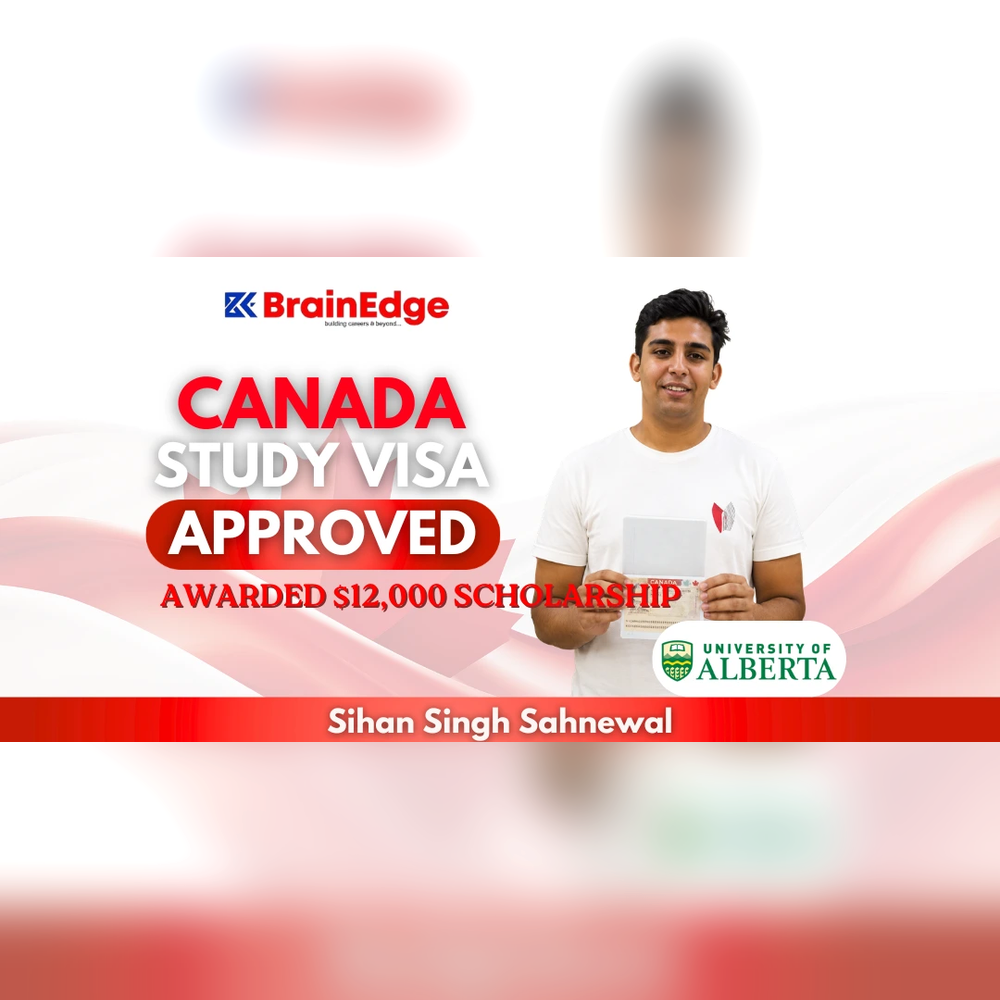
"I sincerely thank BrainEdge Education Pvt. Ltd. for their exceptional support throughout my Canada Study Visa journey and for helping me secure admission to the University of Alberta with a CAD $12,000 scholarship. Their expert guidance made the entire process smooth and successful, and I highly recommend BrainEdge to anyone planning to study in Canada."
Highlight: $12,000 Scholarship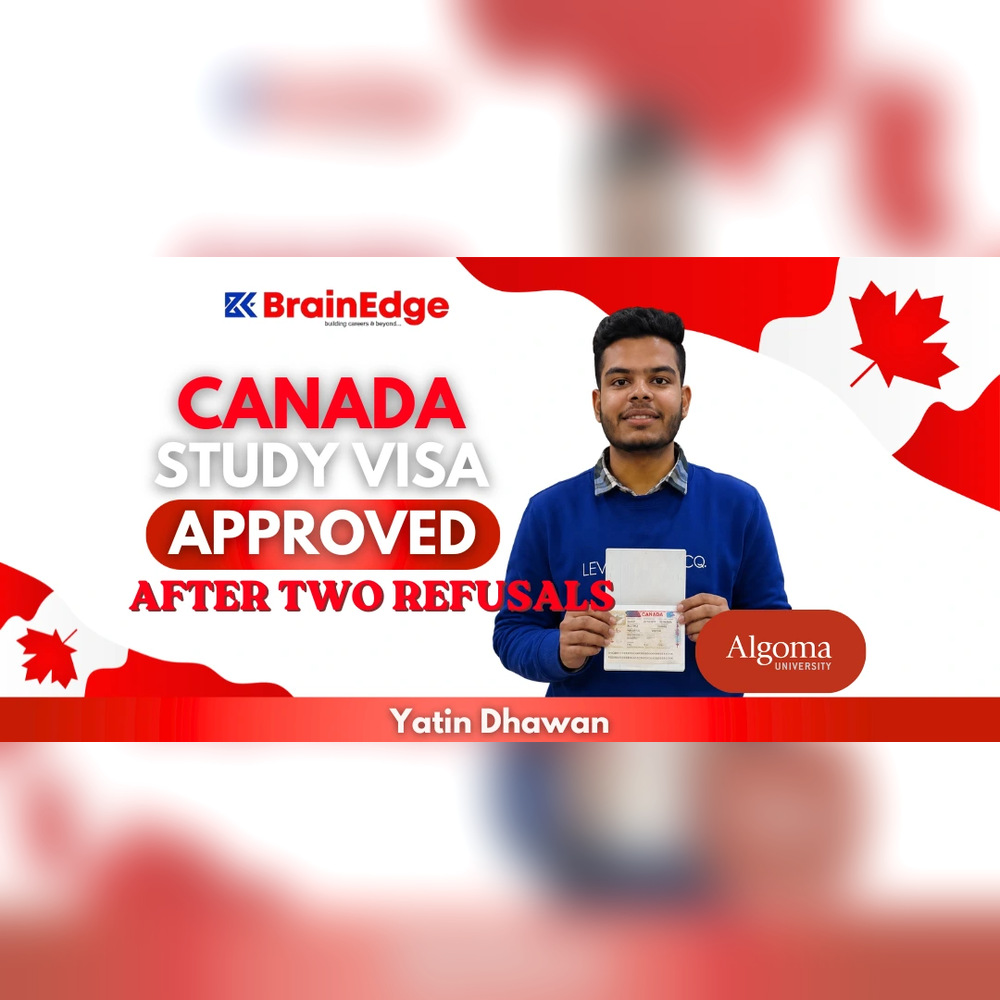
"After facing two Canada study visa refusals, I finally achieved my dream of studying in Canada with the expert guidance and strong visa strategy of BrainEdge Education Pvt. Ltd. Their dedicated support helped me secure my Canada Study Visa for Algoma University, and I highly recommend BrainEdge as a trusted Canada study visa consultant and immigration expert in Patiala."
Highlight: Approved after 2 Refusals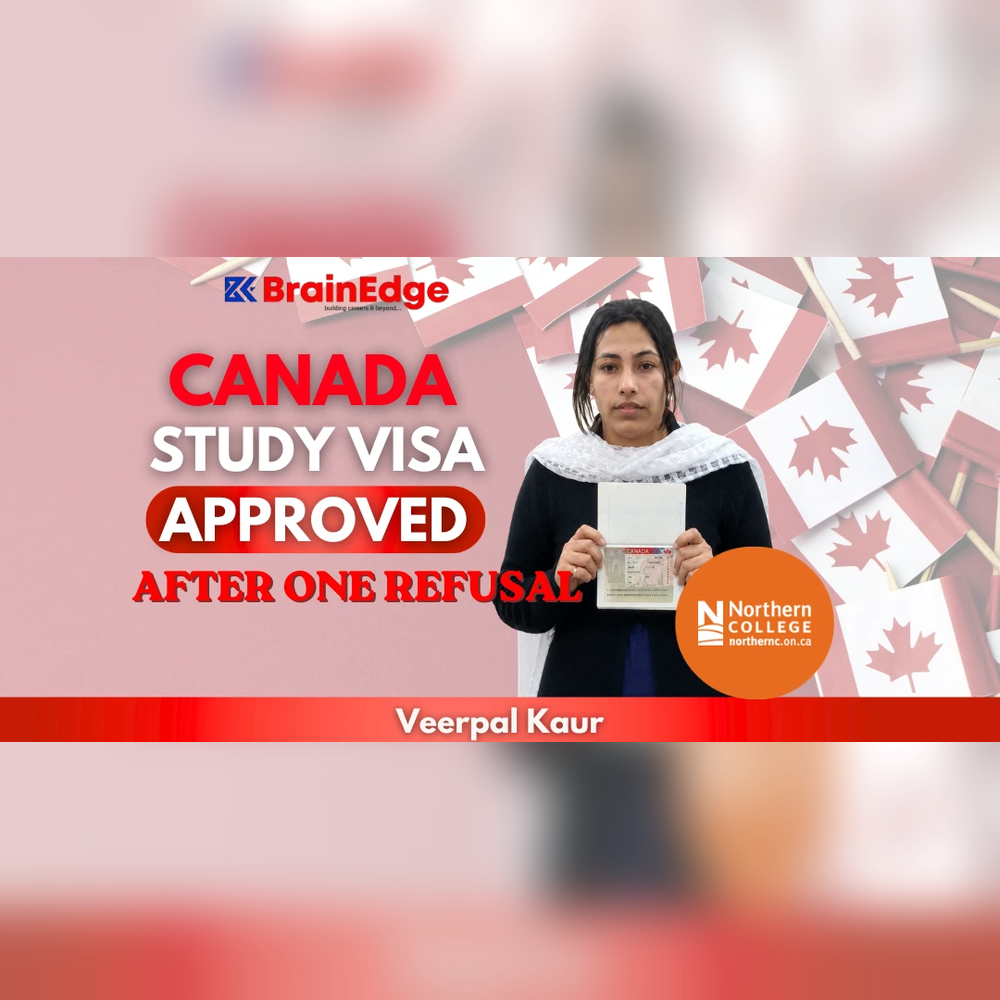
"I am grateful to BrainEdge Education Pvt. Ltd. for helping me achieve my dream of studying in Canada after one visa refusal through their expert guidance and personalized support. Thanks to their dedicated team, I successfully secured my Canada Study Visa for Northern College, and I highly recommend BrainEdge to anyone looking for a trusted Canada study visa consultant."
Highlight: Approved after 1 Refusal
"I'm thankful to BrainEdge Education Pvt. Ltd. for making my dream of studying in Canada come true despite having a 2-year study gap. Their expert guidance and dedicated support helped me secure my Canada Study Visa for Canadore College, and I highly recommend BrainEdge to anyone planning to study abroad."
Highlight: 2 Years Study Gap after 12th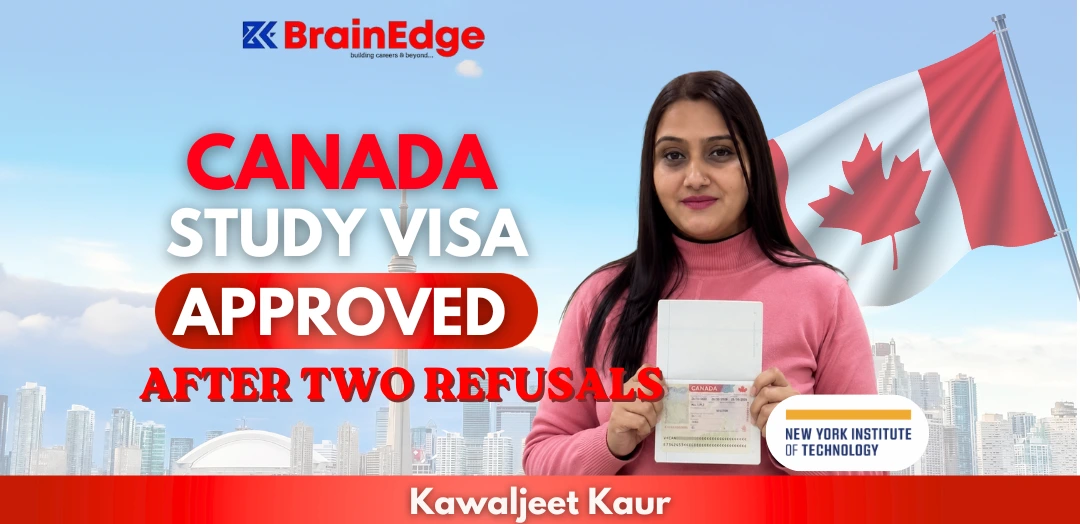
"After facing two Canada study visa refusals, I finally achieved my dream of studying in Canada with the dedicated support of BrainEdge Education Pvt. Ltd. Their professional counseling and strong visa strategy helped me secure admission to the New York Institute of Technology, Canada, and I highly recommend BrainEdge for reliable Canada immigration and study visa services."
Highlight: Approved after 2 RefusalsDownload: Canada Study Visa Checklist (2026)
Get the complete, up-to-date 2026 Canada Study Permit Checklist directly to your WhatsApp. Enter your number below to receive the instant download link.
Canada Study Visa Consultancy: Fees & What's Included
We keep fees transparent because hidden costs are a trust-killer. Your assessment is free; if you proceed, you receive a clear scope and a clear price before any commitment. A typical engagement includes:
- Eligibility review and refusal-risk assessment
- Course and DLI shortlisting, with PGWP/CIP checks
- University/college application support
- SOP development around the genuine-student framework
- Financial documentation and fund-sourcing support
- Full application audit and visa filing
- Refusal recovery, where needed
There are no guaranteed-visa packages here, because no honest consultant can sell one — IRCC makes the decision.
Book a Free Canada Study Visa Assessment
Start where every strong application starts — an honest assessment. We'll review your profile, flag the risks, and tell you plainly whether a Canada study permit is realistic now and what to strengthen first. No pressure, no guarantees, just clear advice from a licensed, ICEF-recognised team.
Book your free Canada study visa assessment.Visit Our Patiala Office or Connect Online
BrainEdge India — SCO - 28/29, City Centre, Near 22 No. Phatak, Near Jaggi Sweets, Patiala - 147001, Punjab.
Phone: +91-98769 00205
Frequently Asked Questions
Not everyone does, but most regular-stream applicants benefit. Since SDS ended, IRCC scrutinises fund source, study-plan logic and ties more closely. A straightforward, well-funded master's applicant at a public DLI may manage alone.
Typically a GIC of CAD 22,895 for first-year living costs plus first-year tuition proof. Verify the current GIC figure with IRCC — it has changed more than once — and document the source and seasoning of your funds.
No. SDS was discontinued in late 2024. All applicants now use the regular stream, where financial evidence and study-plan logic are examined more closely than under the old GIC-plus-tuition shortcut.
A Provincial Attestation Letter confirms your application falls within a province's allocation. Most applicants need one; some master's and PhD students at public DLIs are often exempt. Confirm your status with IRCC.
It depends on the slowest stage — admission, PAL, GIC, biometrics and IRCC processing. PAL and IRCC processing are the usual bottlenecks and vary by season. Check the live IRCC estimate for India before fixing an intake.
Eligible students can work off campus up to 24 hours per week in session and full-time during scheduled breaks. Work-hour rules changed recently, so confirm the current limit and your eligibility with IRCC.
Check that it leads to a PGWP and, for many diplomas, that its field of study maps to an eligible CIP code. Near-identical programs can differ, so verify each shortlisted program against current IRCC PGWP rules.
A generic SOP, recently-deposited or unsourced funds, unexplained gaps, a missing PAL, a non-PGWP course, weak ties, and inconsistent documents. Most are avoidable with a properly audited application.
Yes. Order your GCMS notes, fix the specific weakness, and reapply with stronger evidence. Always disclose previous refusals honestly — concealing them is misrepresentation under IRPA and can trigger a ban.
For many graduates, study plus post-graduation work can become a step toward PR. IRCC recognises dual intent, but you must still satisfy the officer you'd leave if PR doesn't materialise. PR is a separate process — see our Canada PR pathways.